An ACL tear is one of the most common sports injuries seen in the clinic, especially among footballers, cricketers and recreational runners. The ligament rarely heals on its own once completely torn, which is why arthroscopic reconstruction is advised for active patients or anyone whose knee keeps giving way.
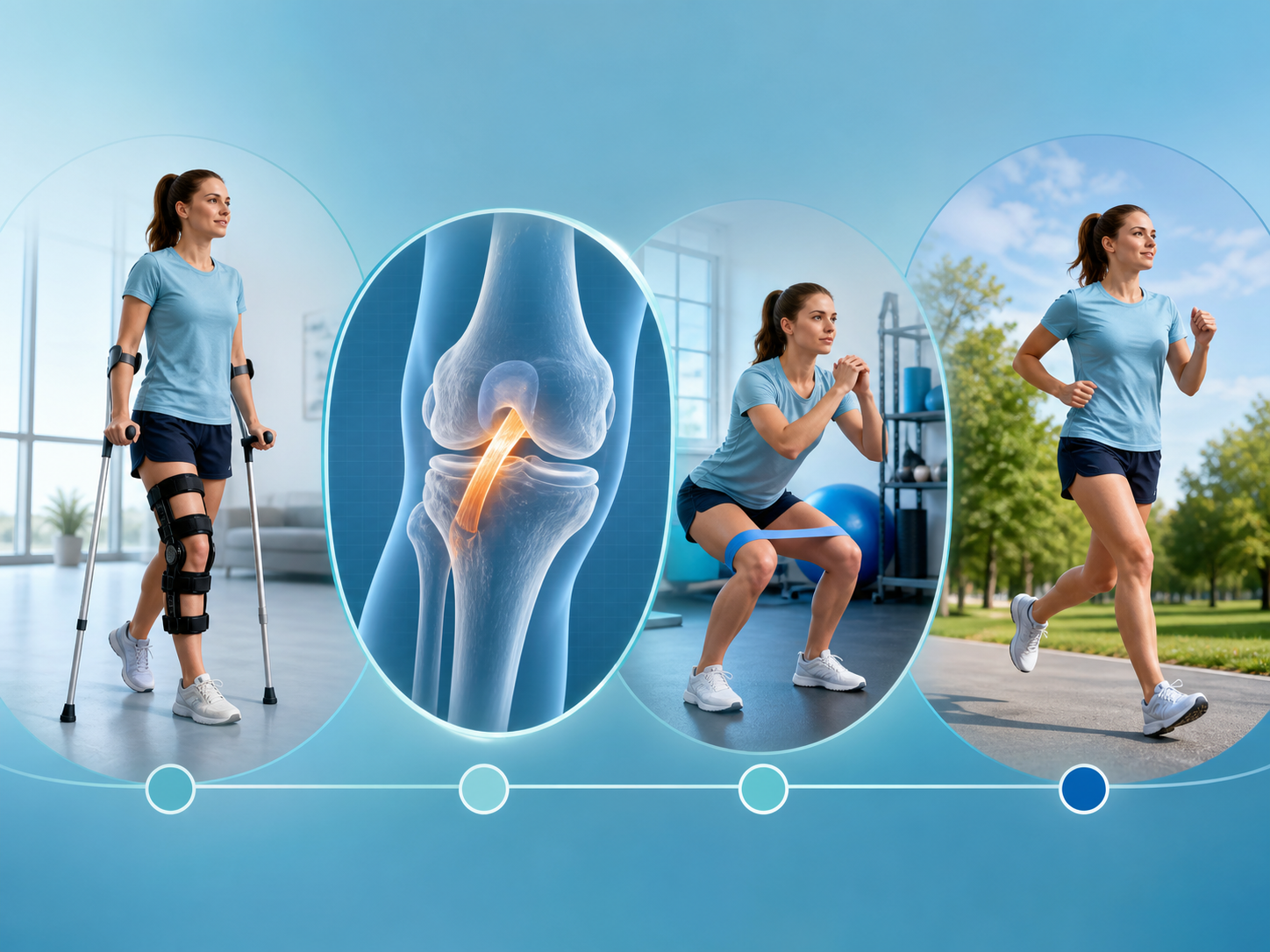
Weeks 0–2 focus entirely on calming the knee down: swelling control, full passive extension, quadriceps activation and safe walking with support. Getting the knee fully straight in this phase matters more than bending it far.
Weeks 2–6 restore range of motion and normal gait. Most patients walk without support by the third or fourth week and return to desk work early. Stationary cycling usually begins around week four.
Months 2–5 build strength — closed-chain squats, step-ups, hamstring work and single-leg balance. Running on flat ground is introduced only when strength and control benchmarks are met, not simply because a date has passed.
Months 6–12 cover agility, cutting, plyometrics and sport-specific drills. Return to competitive sport is cleared at 9–12 months after strength testing, because returning too early is the single biggest cause of re-tear.
Every plan is individual. Age, graft choice, associated meniscus injury and how disciplined the rehab is all change the timeline.
About the author
Dr. Shreyas M.J
Consultant Orthopaedic Surgeon in Mysuru specialising in arthroscopy of the knee and shoulder, joint replacement, foot & ankle surgery and trauma care. Fellowship-trained in arthroscopy and sports medicine (India, Australia and Thailand) and Assistant Professor at JSS Hospital.
Read full profile →This article is general information and not a substitute for a clinical examination. For advice on your specific problem, book a consultation at the clinic.